
Year 5 Explore Crime and Punishment with Local Police Visit
Published on 05/12/25
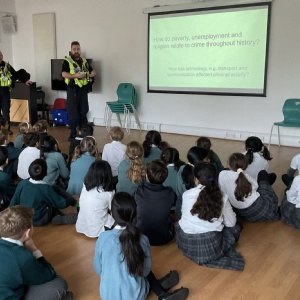
This half term, Year 5 have been learning all about Crime and Punishment through history. On 27 November, two members of the neighbourhood policing team visited us at Cambridge Junior School to teach the children about modern crime and policing.
It was a real relief to learn that ordeal by fire or water, executions and torture are no longer a part of our criminal justice system. But PC Jake Waldron also pointed out some similarities with the past. Juries were invented by the Romans and still play a big part in modern crime and punishment. Similarly, neighbourhood watch schemes are very important now, just as the hue and cry was used by the Anglo Saxons to catch wrong-doers.
One similarity that was noted was that poverty still plays a big part in committing crime. We have learnt how, in Tudor times, there were problems with unemployment due to a growing population. We also learnt that, in the Anglo-Saxon times, food supplies were dependent on a good harvest and that meant food would be very expensive in years with a bad harvest. This meant there could be a lot of theft. Similarly, PC Waldron noted that people do still commit crimes out of desperation. He said this was a particular problem when people have addictions, and need money to fund their addiction. He explained that the Neighbourhood Policing Team work hard to help people in desperate circumstances, to help them avoid committing crimes again.
Rafi said: “I am surprised that only really bad people go to jail’. In fact, PC Waldron explained that lots of offenders face consequences like attending a course to learn the impact of shoplifting, or writing a letter of apology for hitting somebody. He said that people need to be allowed to learn from their mistakes, so it isn’t always right to send them straight to prison.”
Sergeant Kevin Sutcliffe talked about the difference between crime prevention and crime detection. He said that it is much cheaper and better to prevent crime rather than detect it. He said it is amazing how much difference small changes can make, such as good street lighting, which can make people think twice before committing a crime. He explained how CCTV can be used both to prevent and detect crime, and how the police use fingerprints as well. Samaira said: “it’s awesome that they use CCTV cameras so there are no misunderstandings.”
Next, the police officers were kind enough to take time to answer some of the pupils’ questions. Year 5 had come up with some great questions, from ‘how many crimes do you address in a day?’ to ‘when do you get to turn on the sirens in your police car?’. As a result, we learnt a lot during the Q and A session.
For example, Alia and Anaya were surprised to learn that the age of criminal responsibility is ten. Anaya said: “We can do bad things until we are ten and nothing will happen – how can that be right?” Sergeant Sutcliffe explained that the age was set by the government and children younger than that were considered too young to know right from wrong. He also pointed out that something must be very wrong at school or at home for young children to have got in a situation where they can commit crimes.
Ivan asked the police officers how they felt about detention, because Year 5 are writing discussion texts in English which debate whether detention is effective or not. The police officers both were in favour of detention and said they felt it was important that people had a chance to reflect on their choices.
All in all, it was a truly enriching experience and the pupils gained a much better understanding of what the police do. Sergeant Sutcliffe finished by reminding children how they could contact the police, using 999 in an emergency, and calling 101 or visiting the police website in less urgent circumstances.